Glennkill
Three Bags FullGlennkill is both a village and the pastoral landscape around George Glenn’s sheep, a place where a green coastal idyll becomes the scene of a killing, an investigation, and a struggle over who has the right to define the land. The flock experiences its meadows, cliffs, paths, barn, and garden as a lived home; human visitors see scenery, opportunity, or a setting for secrets. That difference in perspective makes the landscape central to the novel rather than a decorative backdrop.
Landscape and the flock’s home
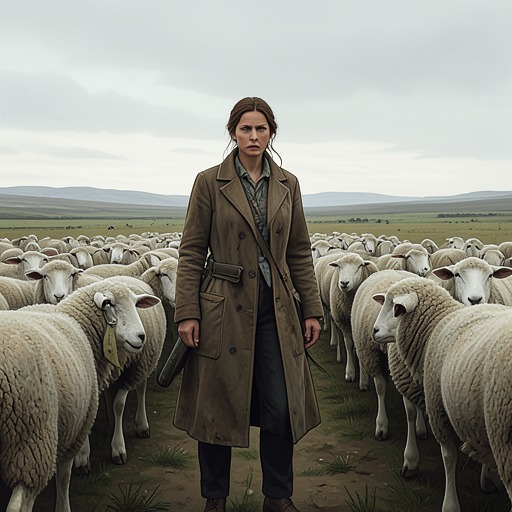
The sheep’s world opens on green Irish grass beside the hay barn, not far from a path through the fields. George lies motionless there with a spade protruding from his body, while a crow examines him and a rabbit sits nearby. At a distance, close to the cliff’s edge, the flock holds a meeting. The scene gathers several sides of Glennkill into one view: the familiar pasture, a route through it used by people, the exposed cliff, and the startling human violence at its center.
The flock’s response makes clear that the pasture is not simply scenery. Their first alarm concerns who will bring hay, and fear of a wolf briefly spreads, but Miss Maple steadies them by pointing out that midsummer grass is plentiful and that a spade is not how a wolf kills. The sheep are proud of having kept calm. Their practical knowledge of the season and the ground gives them a way to interpret the death that differs from human assumptions. Even the danger is first understood through the routines of grazing and care that George’s presence had organized.
The following morning, without either shepherd or sheepdog, the animals hesitate before leaving the barn. Once outside, they run across the meadow toward the steep cliffs and back again, turning their newly unguarded landscape into a space of exuberant movement. That freedom leads directly to George’s vegetable garden behind his caravan. The garden’s lettuces, peas, radishes, cress, tomatoes, endives, buttercups, and chives had been fenced off from the sheep. With George gone, Lane pushes back the bolt, and Maude, Cloud, and Heather graze different beds until the orderly plot is stripped. Their raid ends in silence and shame. The place is abundant, but abundance has been organized by rules and ownership.
The village and its visitors
Glennkill is not isolated from human movement. People use the footpath from Golagh toward the village; Tom O’Malley comes along it on his way to the local pub. Seeing the sheep grazing peacefully and one perched on the cliff, he imagines the view as a travel brochure and decides that tourism might be the village’s future. His passing thought anticipates the economic pressure that will make the pasture desirable to people beyond the flock.
The village’s apparent remoteness is itself treated as a selling point. A woman talking with Beth observes that people will flock to a place once it is presented as isolated: the promise of solitude attracts crowds. Glennkill’s quiet is therefore not an escape from commerce but something that can be packaged for it. The contrast is sharp when the flock’s familiar home is praised as a tourist attraction while the sheep themselves remain subject to human plans for the land.
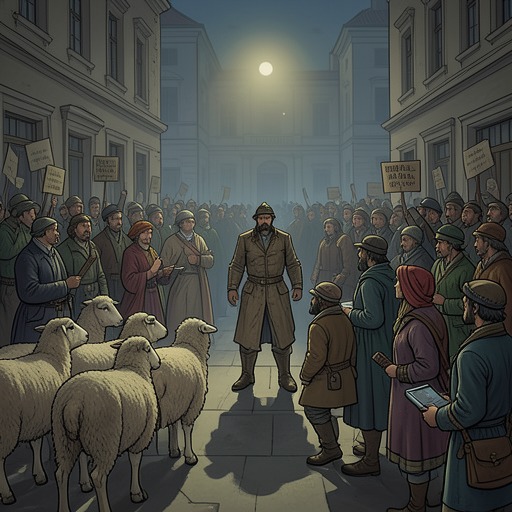
Visitors also alter the flock’s understanding of the village. The sheep have not previously seen a whole human gathering, and they count the people differently: Mopple the Whale estimates seven, Zora twenty, and Miss Maple forty-five. Sir Ritchfield loses track and counts people and sheepdogs more than once. The procession is led by Tom, followed by children, women, men, and elderly people. To the sheep, the humans form a flock of their own, though not one led by strength or intelligence in the way they expect. Glennkill’s human community is thus observed from outside its own habitual categories.
Land, money, and violence
The pasture’s beauty intensifies rather than resolves its conflict over value. Tom and Harry the Sinner argue that George’s land could have made money through development and resent his refusal to let people onto it. Their account also turns George’s isolation into suspicion: they allege that boats brought drugs from the beach at night, that contraband was taken to his caravan, and that he drove it away the next day. For them, the prospect of a drugs scandal threatens tourism schemes; for the sheep, the same land is the place where their shepherd lived and where he was killed. The competing interpretations expose how quickly a landscape can be translated into property, profit, or evidence.
The flock’s view of human land use becomes more disturbing when Gabriel arrives with his flock and cuts grass using George’s scythe. The sheep have seen George polish the blade but have not understood its purpose. In Gabriel’s hands it passes through the grass with a hostile, singsong sound, leaving the cut blades flat while he appears to graze without wanting the grass. The sheep experience this not as ordinary pastoral labor but as senseless destruction. A tool associated with George’s care of the land becomes an image of a different relationship to it: the human can take or destroy what the sheep understand as their sustenance.
Hidden histories in the landscape
Glennkill’s quiet also conceals violence that predates George’s death. Rebecca tells Beth that newspaper files place Wesley McCarthy’s murder at the stone quarry seven years earlier, when Beth was in Africa. An anonymous caller reported the body, but there were no suspects or arrest, and the story quickly disappeared from the headlines. Beth recognizes the name as Weasel McCarthy and clutches the pendant at her neck. The quarry is not merely another feature of the surrounding area: it anchors an unresolved history that reaches into the village’s present.
The sheep connect that earlier killing to George’s absence. After Melmoth returns, Miss Maple reasons that George discovered his flock was the wrong one: it had killed McCarthy, and its members were wolves concealed among sheep. She interprets George’s departure not as simple abandonment but as a response to discovering the crime and wanting it exposed. In her account, the pasture becomes a place where the distinction between a true flock and a murderous one has moral force. The sheep’s investigation is rooted in their own idea of belonging, but it also brings a buried human crime into view.
A public village, an unresolved case
Human attempts to make Glennkill public recur in formal settings as well as on the path and pasture. George’s will specifies a public reading beneath the old village lime tree on the Sunday following his death, or one Sunday later, at noon. When the lawyer looks up into the canopy, a leaf lands on his tailored shoulder; he pauses to consider whether the tree is indeed the village lime. The small uncertainty gives the gathering an oddly unsettled character: even the place named in the legal instruction must be identified before the community can hear what George has arranged.
At the Smartest Sheep in Glennkill contest, Inspector Holmes sits among tourists and locals, frustrated by the festive atmosphere and by the case of George Glenn. He had suspected the family and considered arresting the heirs for lack of a better lead, but now recognizes the absurd difficulty of arresting a flock. The contest makes the village’s double life visible: an entertainment that draws visitors is also where the unresolved investigation presses back into public view. Glennkill remains picturesque to passersby, but its pasture, quarry, caravan, and gathering places hold histories the tourist image cannot settle. The novel’s landscape is pastoral in appearance and contested in practice, shaped by animal life, human ownership, economic ambition, and crimes the village has failed to resolve.